


Understanding DNA Repair: Visualizing Tumour Suppressors in Action.
The genome is constantly threatened by damaging agents, and accumulated damage can lead to cancer and other genetic disorders. Cells have evolved an intricate…
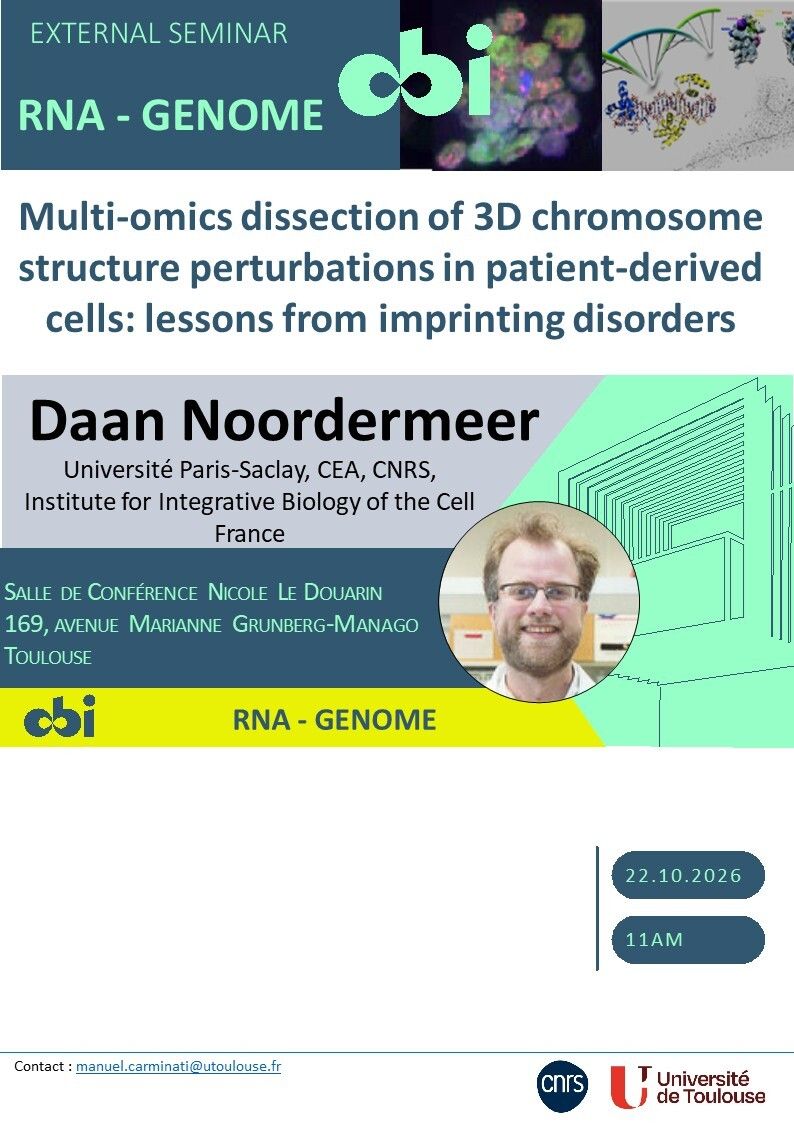
The ~ 100 imprinted genes in mammalian genomes are mono-allelically expressed based on their parental origin (i.e. they are only active on the chromosome inherited from the mother or father). Many of these genes cluster together in 20 imprinted domains where dedicated regulatory elements, the so-called “Imprinting Control Regions” (ICRs), dictate allele-specific transcriptional activity throughout the domain. The ICRs at all domains are distinguished by allele-specific DNA methylation, but how they transmit their regulatory instructions over distance differs from one domain to the other. At a subset of imprinted domains, this regulation involves DNA methylation-dependent binding of the CTCF insulator protein to the ICR. We previously showed in mouse cells that CTCF binding at ICRs creates differential 3D chromatin structure, whereby the formation of allele-specific TADs (Topologically Associating Domains) permit rewiring of enhancer-promoter contacts.
While the study of imprinted domains has provided invaluable insights about epigenetics, chromosome structure and gene regulation, their importance expands to human disease as well: imprinting disorders (IDs) are moderately rare developmental disorders that touch ~ 1 in 5000 newborns. IDs are caused by the abnormal activity of specific imprinted genes, resulting in either the complete loss or bi-allelic activity of imprinted genes. While perturbations in 3D chromosome structure are expected for certain IDs, technical limitations have prevented their direct observations. Such information will be highly valuable, as current diagnostics (incorporating structural variation and DNA methylation changes) frequently fails to explain the underlying molecular causes of IDs.
I will present recent collaborative work where we used multi-omics to characterize perturbations in DNA methylation, CTCF binding and TAD structure in cells derived from Silver-Russell ID patients. These studies confirm that valuable diagnostics insights about allele-specific 3D chromosome structure can be obtained from small samples of patient-derived cells, thereby explaining the mechanisms responsible for abnormal activity of imprinted genes.
The genome is constantly threatened by damaging agents, and accumulated damage can lead to cancer and other genetic disorders. Cells have evolved an intricate…

Pendant deux jours, plongés au cœur du Muséum d’histoire naturelle et accompagnés de l’autrice-illustratrice Claire Schvartz, les enfants expérimentent la…

Atelier de l'idée au projet de l'ESS : construire une réponse utile Un temps collectif pour explorer une problématique sociale et faire émerger des solutions…

Ce 2nd atelier qui s'intitule "Je renforce mes actions et sensibilise autour de moi" permet d'approfondir des les solutions pour réduire les déchet, et de…

Au cœur de la savane africaine, Choubachou, un petit éléphanteau, part avec sa famille à la cueillette de fruits frais et de baies savoureuses. Guidé par sa…

Présenté par Kastone Productions (PLATESV-D-2024-001090) Altremie, c’est pas dans le dictionnaire, mais c’est un néologisme qui représente le mieux ce dont je…

Altremie, c’est pas dans le dictionnaire, mais c’est un néologisme qui représente le mieux ce dont je vais vous parler.Altremie, c’est un mélange entre…

Franck Polo repousse les limites et ose tout sans détour. Franck Polo repousse les limites et ose tout sans détour. Avec un humour plus décapant et incisif que…

Un atelier en deux temps pour comprendre l'usage des motifs et leur dimension symbolique Les motifs ne sont pas uniquement décoratifs. Ils sont porteurs de…
Commentaires
Aucun commentaireUne question sur les horaires, l'accès ou le programme ? Envie de partager vos impressions ? Échangez avec la communauté By Night.