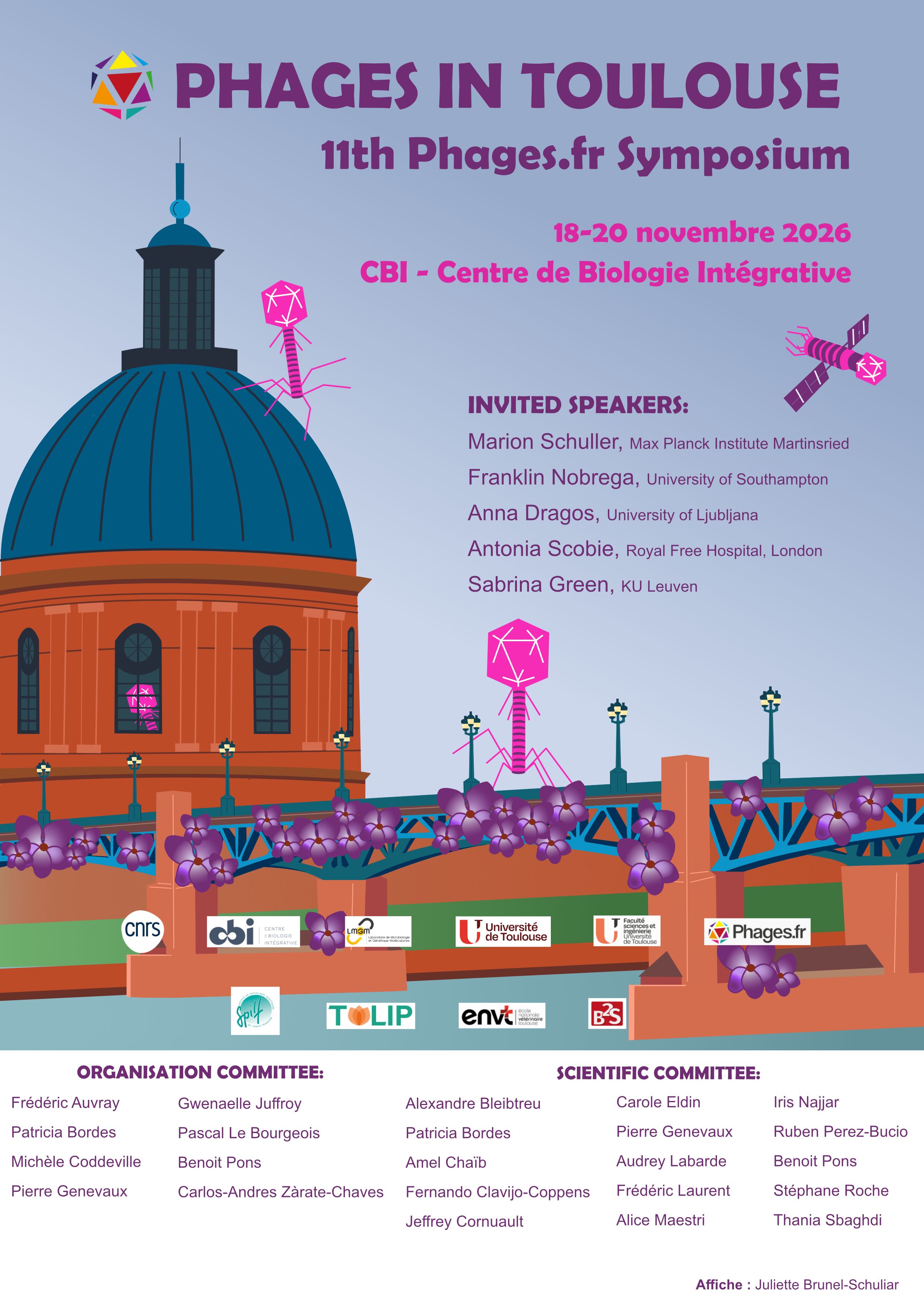
Le colloque “Phages in Toulouse” aura lieu du mercredi 18 novembre (à partir de 14h00) au vendredi 20 novembre 2025 (départ à 13h00) dans les locaux du Centre de Biologie Intégrative (CBI-CNRS) à Toulouse. Il s’agit de la onzième édition du colloque annuel du réseau Phages.fr et cette année encore, nous attendons environ 150 participants. Porté par le CNRS, le réseau Phages.fr fédère chercheurs, cliniciens et industriels autour de thématiques allant de la recherche fondamentale à la thérapie phagique, en passant par le biocontrôle et les applications industrielles. L’objectif du réseau Phages.fr est de rassembler la communauté des équipes françaises impliquées dans la recherche sur les bactériophages, tout en restant ouverte aux équipes internationales. Cinq spécialistes donneront une conférence plénière en ouverture de chaque session afin d’offrir un panorama des recherches en cours et favoriser les interactions entre équipes de domaines variés et complémentaires.
Abstract of the seminar :
Most bacterial genomes carry prophages, yet the effects of these resident viruses on their hosts remain difficult to predict. Accessory phage genes are poorly characterized, and their effects often depend strongly on environmental conditions, which can vary considerably over the lifetime of a bacterium.
To map prophage regulatory responses and identify conditions relevant to phage–host interactions, we first mined publicly available transcriptomic datasets to identify phage genes most responsive to changing growth conditions. This analysis also revealed the culture conditions that had the greatest impact on prophage gene expression. Guided by these findings, we constructed lysogenic and non-lysogenic strains and generated new transcriptomic datasets to investigate how lysogeny alters host gene expression and how the host genetic background influences prophage transcriptional responses.
These comparisons revealed how regulatory control is distributed between the prophage and its host, highlighting processes in which either partner dominates. We further investigated the functional consequences of these interactions using phenotypic assays and single-cell imaging. Beyond B. subtilis, our approach provides a framework for studying other phage–host systems, particularly in model bacteria for which extensive transcriptomic data are already available, but the effects of resident prophages remain poorly characterized. Our findings also raise broader questions about the balance of regulatory control between prophages and their bacterial hosts.
Abstract: One of the conserved pathways for RNA degradation in eukaryotes, NMD, is triggered by a translating ribosome that encounters a premature termination…
Le rôle physiologique et les voies de dégradation des ARN médiée par l’Exosome reste encore à éclaircir chez les archées, et notamment chez les archées…
Circular RNAs (circRNAs) result from the covalent ligation of the 5' and 3' free ends of linear RNA, making them more resistant to exonucleases and therefore…
Abstract: Hyperthermophiles are exclusively archaea and bacteria that thrive under extreme high temperatures with some species tolerating temperatures higher…
This thesis focuses on HAN, a member of the DHH superfamily, initially proposed to participate in DNA replication fork restart through its interaction with…
"Genetic Warfare: How MGEs Manipulate Host Surface Architecture from within" (Olaya) "Overview of the ddPCR device (droplet digital PCR) for those who haven't…
Jeudi 19 novembre 18h Réalisé par Fanny Molins - France - 2022 - 77 min À l'Atlantic Bar, à Arles, Nathalie, la patronne, est le centre de l'attention. Ici, on…
On démarre un bal régulier en centre ville de Toulouse tous les 3eme jeudi de chaque mois, en écho aux rencontres musiciens danseurs des 1er jeudi. Cette…



Commentaires
Aucun commentaireUne question sur les horaires, l'accès ou le programme ? Envie de partager vos impressions ? Échangez avec la communauté By Night.